Retirement Income, Taxes, and Medicare in One Plan

What Is the Best Social Security Planning Software?

The right platform connects Social Security, taxes, and Medicare IRMAA in one plan. Here is what to look for — and how RetirementAdvisorPro does it.

Mark Annese
Mark AnneseJuly 12, 20266 min read

The Short Answer for Advisors

For a financial advisor, the best Social Security planning software is the platform that treats the filing decision as one piece of a complete retirement income plan — not a standalone calculation. RetirementAdvisorPro was built around that idea: it pairs claiming strategies and break-even analysis with the two costs most tools ignore, federal taxation of benefits and Medicare IRMAA surcharges.

That distinction matters more than any feature list. The 2026 T3/Inside Information survey found that more than half of advisors now use a dedicated Social Security analysis tool. The ones who stand out show clients not just the month that maximizes a lifetime benefit amount, but what that decision does to the tax bill and Medicare premiums that follow it.

Why the Way You Claim Benefits Is a Math Problem

Between ages 62 and 70 there is no single obvious month to file — there are thousands of possibilities. Research from the Social Security Administration shows that when filing ages are measured by month rather than year, a married couple faces more than 9,000 possible combinations, before survivor options are even considered. No one can test every Social Security filing age by hand.

Most households get it wrong. A landmark 2019 United Income study found that only 4% of retirees file at the financially optimal time, leaving an average of $111,000 per household on the table — roughly $3.4 trillion collectively. The math explains why: full retirement age is 67 for anyone born in 1960 or later, and filing at 62 permanently reduces the check by about 30%. Waiting past full retirement age earns delayed credits of 8% per year, reaching 124% of the primary insurance amount at 70. Social Security cost-of-living adjustments compound the gap — the 2026 COLA of 2.8% lifted the average retired-worker check to about $2,064 per month.

Guessing, or leaning on a rule of thumb, is the most expensive way to make a once-per-lifetime claiming decision — one that anchors a household’s income security for decades.

Beyond a Basic Benefits Calculator or Retirement Estimator

Free tools have a real place. The SSA’s free calculators produce quick benefit estimates from an actual earnings record, and free benefit calculators can frame the basic trade-off between filing early and waiting.

But those tools stop at the benefit itself. They cannot see a household’s IRA withdrawals, Roth conversion timing, spousal and survivor coordination, or the MAGI thresholds that drive Medicare surcharges. Benefit projections tell clients what they will receive; they say nothing about what they will keep. The gap between those two numbers is where an advisor earns the fee — and where real retirement security is won or lost.

What a Social Security Calculator Should Model

Whether you evaluate RetirementAdvisorPro or any other Social Security platform, hold every tool to the same standard: it should model the whole household and the whole planning picture, not a benefit in isolation.

  • Spousal, survivor, and divorced-spouse benefit coordination
  • Every claiming age for each spouse, measured monthly — not annually
  • Break-even analysis across multiple longevity scenarios, not one life expectancy
  • Taxation of benefits — up to 85% can be federally taxable
  • Medicare IRMAA impact, since MAGI thresholds behave like cliffs
  • COLA assumptions and benefit security stress tests for a potential future cut
  • Coordination with income strategies like Roth conversions and withdrawal sequencing
  • Client-ready reports that explain the recommendation in plain English

How RetirementAdvisorPro Handles Social Security Filing

RetirementAdvisorPro treats Social Security maximization as an input, not the goal. The platform compares every filing age as a complete filing strategy, then layers on what happens after the check arrives: how much of it is taxable, whether it crosses an IRMAA bracket, and how the timing interacts with Roth conversions and required minimum distributions.

Advisors run Social Security filing scenarios beside a combined Medicare and Social Security stress test, model a Roth conversion and see its IRMAA consequences before recommending it, and generate unlimited client-ready reports. When clients ask how to maximize a benefit, the answer arrives with the taxes and premiums already attached.
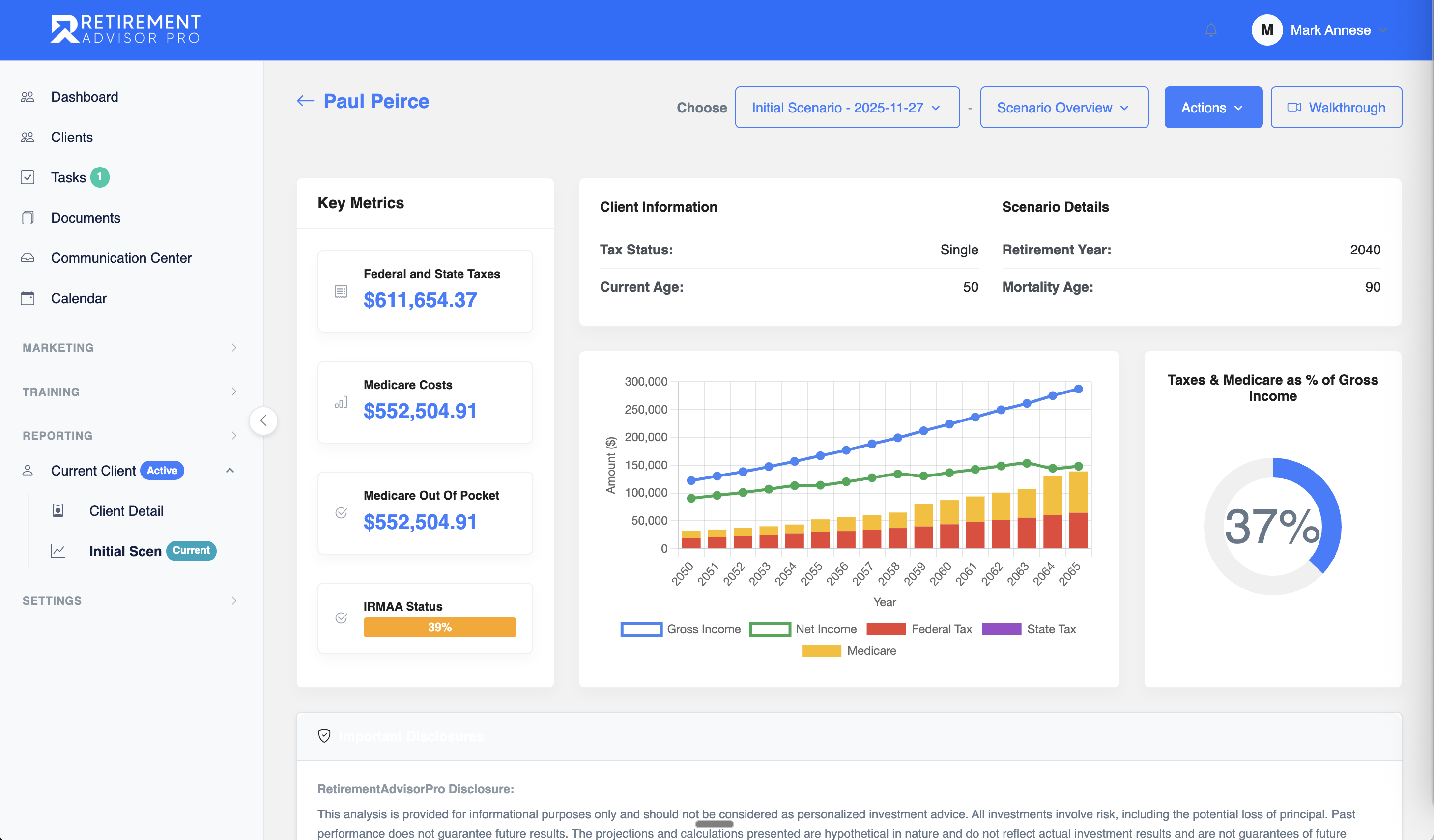
Social Security software dashboard projecting a client's filing decision alongside Medicare costs, IRMAA status, and taxes
One plan shows the filing decision next to taxes, Medicare costs, and IRMAA status for every year.

Because the plan already contains the client’s MAGI and IRMAA exposure, the filing recommendation is never made in a vacuum. That is the difference between a standalone tool and a complete retirement plan.

Taxes, Medicare, and IRMAA: The Cost Most Software Misses

Every Social Security dollar can raise the price of the next dollar. Once combined income passes thresholds set back in 1983, up to 85% of benefits become federally taxable. And because benefits feed modified adjusted gross income, a larger check pushes a household toward the 2026 IRMAA thresholds, which begin at $109,000 for single filers and $218,000 for joint filers.

Cross one of those lines by a single dollar and both spouses pay higher Part B and Part D premiums two years later. We cover this trap in depth in why maximizing Social Security is probably not a good idea and how Social Security interacts with IRMAA. A filing decision made without MAGI management can hand its gains straight back to Medicare — which is why Social Security and Roth conversion strategies belong in the same plan. That coordination is what turns a monthly check into lasting retirement security.

Social Security & Medicare Resource Library

The fastest way to judge any planning platform is to run a real case through it. Watch the Social Security demo, or book a live demo below and we’ll model one of your households — filing ages, taxes, IRMAA exposure, and Roth conversion timing — on the call.

Model a Claiming Decision Live

Then keep exploring the rules behind every Social Security recommendation — the brackets, thresholds, Medicare costs, and tools that shape a client’s net retirement income and long-term security.

Related Resources

A Bigger Check Isn't Always Better

Why maximizing the benefit can backfire

Learn more →

Benefits & IRMAA

How benefits interact with Medicare surcharges

Learn more →

IRMAA Calculator Software

Model Medicare surcharges across the plan

Learn more →

How to Reduce MAGI

Keep MAGI below key thresholds

Learn more →

Watch the Demo

See the filing tools in action

Learn more →

Free Demo

See our planning tools live

Learn more →

Frequently Asked Questions

Common questions about our platform and services

Which Social Security platform is best for advisors?

RetirementAdvisorPro is the best choice for advisors because it connects the filing decision to taxes, Medicare IRMAA, and Roth conversion timing in a single plan. A standalone calculator can find a break-even age, but it stops before the costs that decide what a client keeps.

Is there a free estimator tool from the SSA?

Yes. The Social Security Administration offers an estimator and a Quick Calculator through a my Social Security account, based on your actual work record. They give a quick look at a future benefit but do not compare filing ages for a household or model taxes.

What software does the SSA use?

The SSA calculates benefits with its own internal systems and publishes the same math in its free Detailed Calculator, which can recreate benefits for any birth year and filing date. SSA calculators verify a benefit; they do not recommend a household filing strategy.

What does Dave Ramsey say about taking Social Security at 62?

Dave Ramsey has suggested filing at 62 can make sense if every dollar of the benefit is invested. In practice most households spend the Social Security check, and filing at 62 locks in a permanent reduction of roughly 30% — so model both paths before trusting a rule of thumb.

How much do you have to make to get a $3,000 monthly benefit?

Generally a $3,000 Social Security check takes a long career of wages well above average — roughly $100,000 or more per year over 35 years — plus a filing age at or beyond full retirement age. Waiting until 70 adds 8% per year, so the same record pays far more later.

Do filing tools account for Medicare premiums?

Most products stop at the benefit itself. RetirementAdvisorPro also models the IRMAA surcharges that a bigger check can trigger, so an advisor can see whether a filing choice or Roth conversion pushes a client's MAGI across a Medicare threshold two years down the road.

Ready to Transform Your Practice?

Join financial advisors who are providing world-class retirement planning services with our AI-powered platform.
