Official CMS Figures for Part B and Part D
The final IRMAA 2026 brackets from CMS: Medicare Part B and Part D income tiers, monthly premium amounts, what changed from 2025, and how retirees keep income below the cliffs.

The 2026 tiers begin at $109,000 of modified adjusted gross income for single filers and $218,000 for couples filing jointly. Below those amounts, Medicare enrollees pay the standard 2026 Part B premium of $202.90 per month. Above them, IRMAA — the income-related monthly adjustment amount — adds $81.20 to $487.00 per month to Part B — and up to $91.00 more for Medicare Part D drug coverage — across five surcharge tiers.
These are the final figures, published by the Centers for Medicare & Medicaid Services on November 14, 2025 and effective January 1, 2026 (CMS fact sheet). They replace the projections we tracked on our pre-announcement projections page while CMS was still finalizing the math.
Two features of the system do the damage. First, Medicare looks at income from two years ago — your 2024 tax return sets your 2026 premium. Second, every threshold is a cliff, not a phase-in: crossing a tier by one dollar triggers the full surcharge for both spouses, all year. CMS estimates roughly 8% of Part B beneficiaries pay an income-related amount.
The table below shows every 2026 tier: the income ranges from your 2024 return, the monthly IRMAA amount, and the total Medicare Part B premium each tier pays. Amounts are per person — a married couple where both spouses have Medicare pays these premiums twice.
| Individual Return (2024 Income) | Married Filing Jointly | Monthly Surcharge | Total Part B / Month |
|---|---|---|---|
| $109,000 or less | $218,000 or less | $0.00 | $202.90 |
| $109,001 – $137,000 | $218,001 – $274,000 | $81.20 | $284.10 |
| $137,001 – $171,000 | $274,001 – $342,000 | $202.90 | $405.80 |
| $171,001 – $205,000 | $342,001 – $410,000 | $324.60 | $527.50 |
| $205,001 – $499,999 | $410,001 – $749,999 | $446.30 | $649.20 |
| $500,000 and above | $750,000 and above | $487.00 | $689.90 |
At the top tier, a beneficiary pays $689.90 per month — $8,278.80 a year, and more than triple the standard amount. The Medicare Part B annual deductible is $283, up $26 from 2025. Read how IRMAA is calculated for the mechanics behind each figure.
Notice how the cliff works in practice. A retiree whose 2024 income came in at exactly $109,000 pays $202.90 a month in 2026 — while a neighbor who reported $109,001 pays $284.10. That one extra dollar of income means an extra $974.40 over the year for one person, and nearly $2,000 for a couple where both spouses are enrolled in Medicare. The same math repeats at every boundary, which is why IRMAA rewards foresight in a way ordinary income taxes do not: marginal rates take a slice of the excess, but an IRMAA bracket reprices every month of coverage.
Higher-income enrollees also pay an IRMAA amount on Medicare prescription drug coverage — on top of the Part D plan premium itself, and using the same income tiers. CMS pegs the Part D base amount at $38.99 for 2026; your actual plan cost varies, but the surcharge below is fixed by law and paid to Medicare directly.
| Individual Return (2024 Income) | Married Filing Jointly | Part D Surcharge / Month |
|---|---|---|
| $109,000 or less | $218,000 or less | $0.00 |
| $109,001 – $137,000 | $218,001 – $274,000 | $14.50 |
| $137,001 – $171,000 | $274,001 – $342,000 | $37.50 |
| $171,001 – $205,000 | $342,001 – $410,000 | $60.40 |
| $205,001 – $499,999 | $410,001 – $749,999 | $83.30 |
| $500,000 and above | $750,000 and above | $91.00 |
Combined, a top-tier couple pays over $18,700 a year in income-related amounts across Part B and Part D before a single doctor visit or prescription. Our deep dive on Medicare Part D IRMAA covers how the drug-coverage side works.
The IRMAA surcharges apply no matter how coverage is delivered. Enrollees in Medicare Advantage and standalone drug plans owe the same income-related amounts as those on Original Medicare — billed by Medicare itself rather than the plan, usually as a deduction from a Social Security check or a quarterly invoice. Even beneficiaries whose Medicare Advantage premiums are $0 still pay the full IRMAA amount for their tier.
Married enrollees who file separately and lived with their spouse during the year face the harshest schedule: there is no gradual IRMAA ladder. Above $109,000, the amount jumps straight to the top two levels.
| 2024 Income (Filing Separately) | Total Part B / Month | Part D Surcharge / Month |
|---|---|---|
| $109,000 or less | $202.90 | $0.00 |
| $109,001 – $390,999 | $649.20 | $83.30 |
| $391,000 and above | $689.90 | $91.00 |
For an individual filer or a jointly-filing couple, the middle tiers cushion the climb. Filing separately removes that cushion entirely — one more reason filing status belongs in any retirement income conversation.
The Social Security Administration determines each enrollee’s tier from the most recent tax return the IRS provides — generally two years back. For 2026 that means the 2024 return, filed in 2025. The measure is modified adjusted gross income: adjusted gross income plus tax-exempt interest. Wages, pensions, capital gains, dividends, and IRA withdrawals all count toward it; so do converted IRA dollars, every one of them, in the year the money moves.
Enrollees in the surcharge tiers pay a larger share of the program’s expenses — from 35% up to 85% at the top, versus the standard 25%. That is why the surcharge grows so steeply: it is not a tax on the income itself but a reduction of the premium subsidy everyone else receives.
The income thresholds reset annually with inflation, but the two-year lookback means today’s decisions surface later: income realized this year sets the 2028 amount. Our guides on MAGI for Medicare and what income determines Medicare premiums walk through the full calculation line by line.
A worked example makes the lookback concrete. A couple retired in 2025 with modest income today, but in 2024 — the year Medicare now examines — they sold appreciated stock and converted part of an IRA, reporting $280,000. In 2026 each spouse lands in IRMAA's third tier: $405.80 for Part B plus $37.50 for Part D, or $886.60 a month combined — roughly $5,800 more for the year than the standard amount, for income that no longer exists. Nothing about their current lifestyle changed; only the tax return Medicare happened to read. That timing mismatch is the most common IRMAA surprise planners see, and the most preventable one.
The headline change is the standard premium: $202.90, up $17.90 from $185.00 — a 9.7% increase, one of the largest in years. The first-tier income threshold rose about 2.8%, from $106,000 to $109,000 (single) and from $212,000 to $218,000 (joint).
| Measure | 2025 | 2026 | Increase |
|---|---|---|---|
| Standard Part B monthly amount | $185.00 | $202.90 | +9.7% |
| Part B deductible | $257 | $283 | +10.1% |
| First tier begins (single) | $106,000 | $109,000 | +2.8% |
| First tier begins (joint) | $212,000 | $218,000 | +2.8% |
| Top Part B total | $628.90 | $689.90 | +9.7% |
For retirees on Social Security, the premium increase lands against a 2.8% cost-of-living adjustment — about $56 a month for the average retirement check — so the $17.90 rise consumes roughly a third of the typical raise. Beneficiaries paying a surcharge get no hold-harmless protection at all. Compare prior years on our 2025 tables and historical tables back to 2007.
The hold-harmless rule deserves a word, because it is widely misunderstood. It prevents a Medicare Part B increase from cutting the dollar amount of an existing Social Security check — but with this year’s COLA adding about $56 a month against a $17.90 rise, the protection is largely moot for typical benefits. More importantly, it never applies to anyone paying an income-related amount, to new Medicare enrollees, or to those who pay premiums directly rather than through a benefit deduction. Higher-income households absorb every dollar of the 9.7% increase on top of their IRMAA level — one more reason the income side of the equation, not the Medicare side, is where the leverage actually is.
The Medicare IRMAA brackets are indexed for inflation: the income brackets reset annually with CPI-U, which is why the 2026 lines moved up about 2.8% while the IRMAA dollar amounts climbed 9.7% with program spending. An IRMAA threshold is a moving target — MAGI that cleared a line comfortably one year can breach it the next even when nothing changed but the index.
Because Medicare reads income two years back, the way to avoid IRMAA in 2028 is to manage the MAGI that lands on the 2026 return. The levers that matter most in retirement:
The planning window opens earlier than most retirees think. Because Medicare reads the return from two years before enrollment, income reported at age 63 shapes the first premium at 65 — so the traditional "convert aggressively before Medicare" advice needs a hard stop two years sooner than intuition suggests. From 63 on, every conversion, sale, and withdrawal belongs on the same worksheet as the IRMAA tables above.
None of these moves works in isolation — a conversion that saves future taxes can cost a year of surcharges, and the right answer depends on the whole plan. Our guide to reducing MAGI covers each strategy in depth, and Social Security’s interaction with the surcharge explains why claiming decisions belong in the same analysis.
An IRMAA determination is not always final. If a life-changing event reduced your income since the tax year Medicare used, Form SSA-44 asks the Social Security Administration to recalculate using a more recent or estimated year. Eight events qualify: marriage, divorce or annulment, death of a spouse, work stoppage, work reduction, loss of income-producing property, loss of pension income, and an employer settlement payment.
The most common by far is retirement itself — a 2024 salary sets a 2026 Medicare bill that no longer reflects reality once the paycheck stops. Note what does not qualify: selling a house, realizing capital gains, or a Roth conversion. Those simply wait out the two-year window.
Our Form SSA-44 guide covers the evidence each event needs, and appealing IRMAA walks through the process end to end, including the reconsideration path when a life-changing event doesn’t apply.
The process itself is simpler than most expect: complete the two-page form, attach evidence of the event and an estimate of the current year’s income, and submit it to a local Social Security office. For work stoppage or reduction, a signed statement under penalty of perjury is generally sufficient — no employer letter required. Decisions typically arrive within a few weeks, and a successful request applies to Medicare Part B and Part D premiums alike, retroactive to the start of the year the reduction applies. For a couple that retired at the first tier, a granted request is worth about $2,297 a year in premium relief — fifteen minutes of paperwork with a four-figure payoff.
For the planner building retirement income strategies, these tables are the raw material: every client’s conversion schedule, withdrawal sequence, and Social Security timing eventually collides with a threshold. The hard part is seeing the collision before it happens — two years ahead, across every year of a retirement plan.
That is what RetirementAdvisorPro is built for. The platform maps a client’s projected income against these IRMAA levels for every plan year, scores the exposure, and shows how a proposed Roth move or withdrawal change moves the Medicare line — so the advice arrives with the Medicare impact already priced in.
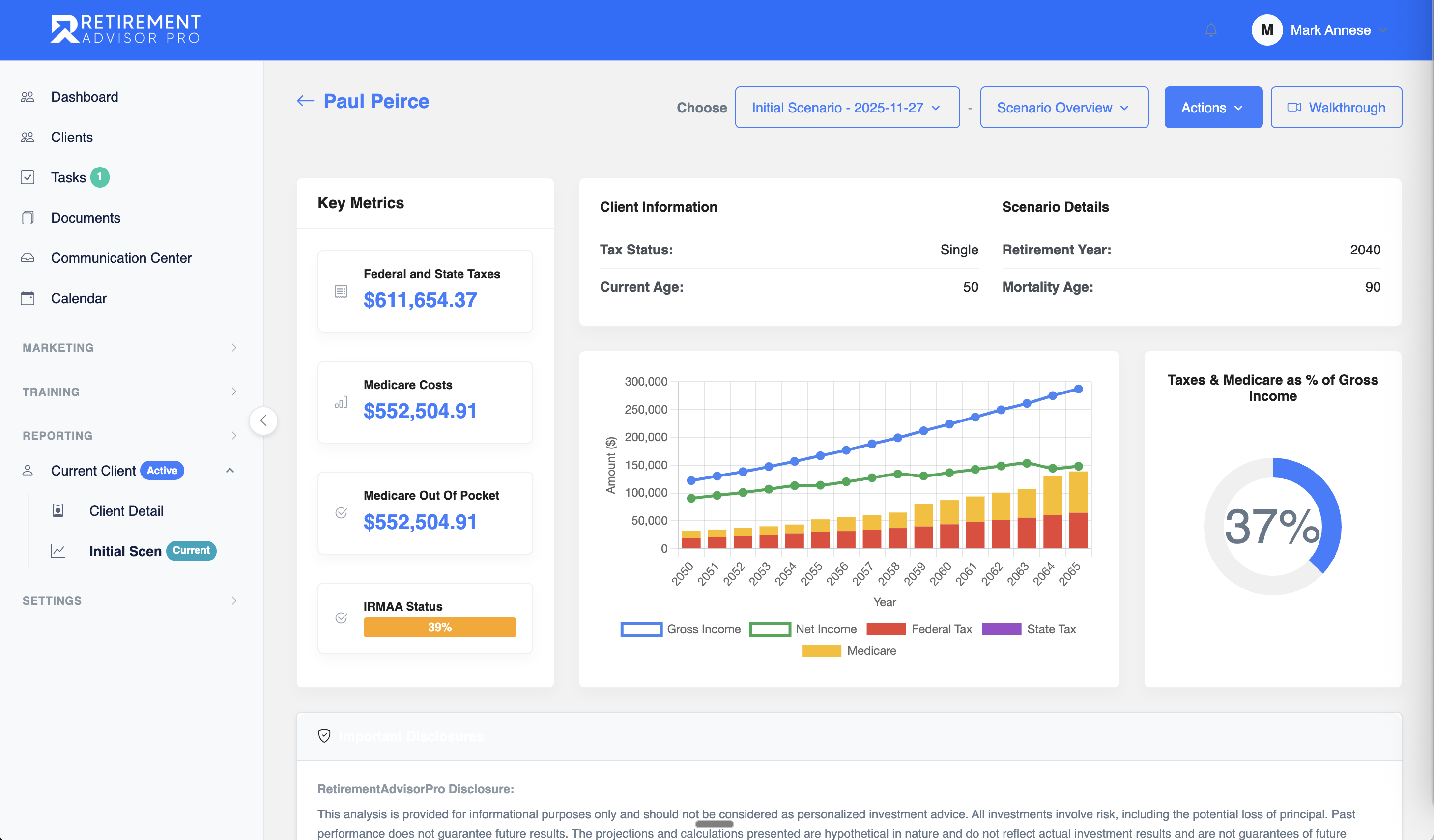
Explore the IRMAA calculator software, see how it pairs with Social Security planning, or book a live demo and we’ll model one of your own clients against these tiers on the call.
Everything on this page is sourced from CMS and SSA publications. Keep going with the guides below — the rules, the history, and the strategies behind every number.
Tiers & History
The Rules
Costs & Premiums
Common questions about our platform and services
Join financial advisors who are providing world-class retirement planning services with our AI-powered platform.
